
 The Real-World Playbook (Before You Start Buying Stuff)
A garage is one of the best spaces for a home golf simulator.
You’ve got depth, you’ve got flexibility, and you’re not fighting interior room layout or furniture.
But here’s the part most people miss:
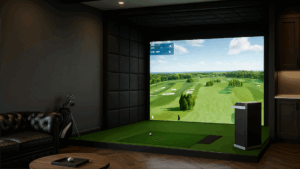
A golf simulator isn’t just a screen, a launch monitor, and a hitting mat.
It’s a swing environment — and if the environment doesn’t feel right, your swing changes.
Which defeats the entire purpose.
So before you start adding launch monitors to your Amazon cart, here’s what actually matters when turning a garage into a true golf studio — not a “hit balls when it rains” setup.
1. Ceiling Height → This Is the Decision Point
Most garages in our area run somewhere between 8’3” and 10’0”.
Here’s the straight answer:
| Ceiling Height | What It Means |
|---|---|
| 8’0”–8’6” | Wedges & irons only (driver will feel guarded) |
| 9’0”–9’6” | Ideal for most players |
| 10’0”+ | Great for tall golfers + full-speed drivers |
Key Point:
You don’t swing under the ceiling — you swing through your shoulder plane.
If the hitting position is too close to the garage door track, confidence is gone.
We often move the hitting spot forward into the room to use the tallest ceiling space.
This is what makes a garage studio play like a golf course swing.
2. Room Depth → This Determines Screen Distance
Most garages have enough depth. The trick is allocating it correctly.
Ideal layout:
-
8–10 ft Ball to screen
-
6–8 ft Ball to back wall
-
Projector throw distance layered above that
If your ball is too close to the screen, your launch monitor reads poorly.
If it’s too far, you lose realism and depth perception.
This is why screen placement is a design step, not an afterthought.
3. Enclosure Geometry & Ball Return
You know what hurts confidence?
Ball bounce-back.
If the screen tension, enclosure depth, or side-wall angle is wrong:
-
You’ll flinch
-
You’ll steer the club
-
You’ll subconsciously slow down
We build enclosures for real ball speed, not showroom demos.
If you hit it hard, we build it to hold.
4. Garage Floors Need Turf Transitioning
Concrete + throw-down mat = sore wrists and thin strikes.
To feel right, you need:
-
A stance platform that’s level with the hitting mat
-
Putting turf that’s even — not sloped
-
Shock absorption so your joints stay happy
When the turf is right, your body trusts the ground.
And when your body trusts the ground, the swing flows.
5. Projector Mounting (This One Surprises People)
If the projector goes in the wrong place, you get:
-
Shadows
-
Washed-out image
-
Distorted aspect ratio
-
Or you literally become the shadow
The projector has to match:
Screen size + throw ratio + mounting height + hitting position.
This is math, not guesswork.
We do the math.
6. Climate Matters on the Coast
Garages around here get:
-
Heat + humidity in the summer
-
Cooler nights in the off-season
Your screen, turf, and electronics need to be rated for the environment.
Otherwise, things warp, stretch, ripple, or fail.
We build to last in coastal conditions.
7. The Confidence Swing Test
Here’s the rule we live by:
If you can’t swing full driver without thinking about the room, the simulator is wrong.
No hesitation.
No “don’t hit the ceiling.”
No steering the club.
A simulator should feel like stepping onto the tee box — not into a closet.
Thinking About a Garage Conversion?
You don’t need to know specs.
You don’t need to choose equipment first.
You don’t need to guess.
Just send:
-
A few photos of the garage
-
Width, depth, and ceiling height
We’ll tell you:
-
What will fit
-
What won’t
-
And your Good / Better / Best build options
No pressure. Just clarity.
<br>
Start Your Build → (Site Planner)
Schedule a Call → (Contact Page)
Coastal Golf Studios
Myrtle Beach • North Myrtle Beach • Conway • Little River • Pawleys Island