
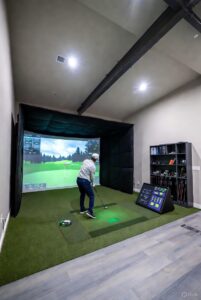
 Hey there, golf enthusiasts! At Coastal Golf Studios, we’re all about elevating your game year-round, rain or shine. Whether you’re dreaming of a basement bunker or a garage grand slam, installing a golf simulator is one of the smartest ways to sharpen your swing without stepping foot on the course. But here’s the swing-killer we’ve seen time and again: cramming your sim into a space that’s too tight. It’s like trying to drive a Ferrari in a parking spot—frustrating and far from fun.The good news? Getting the room size right doesn’t have to be rocket science. In this post, we’ll break down the ideal dimensions, what works when space is at a premium, and why skimping could leave you with buyer’s remorse. Let’s tee off with the basics so you can build a setup that lets you unleash your full potential.
The Gold Standard: Optimum Room Size for Unrestricted Swings
If you’re lucky enough to have a dedicated space where square footage isn’t a concern—think a finished basement or a spacious home office—aim for these dimensions to create a true golf haven:
- Width: 16 feet. This generous berth accommodates (most) both right-handed and left-handed golfers side by side, plus room for that victory dance after a hole-in-one.
- Height: 11 feet. Plenty of clearance for even the tallest players (we’re looking at you, 6’5″ slicers) to swing freely without a second thought. Note: 10′ can work in the right situation.
- Depth: About 16 feet total depth. You’ll want to be around 10′ from the hitting mat to the impact screen or projector wall. This ensures your ball flight has room to breathe, giving accurate launch data and immersive visuals. Davubg some space behind the htting area is ideal for having some chairs or a sofa….and to avoid getting beaned by your buddy’s follow through.
In this setup, you’re not just simulating golf—you’re living it. Full driver swings, wedge chips, and everything in between feel natural, just like the real thing. At Coastal Golf Studios, we’veseen dozens of these dream bays, and the feedback is unanimous: It’s addictive.
Making It Work in Tighter Quarters
Not everyone has a man cave the size of Augusta. If you’re retrofitting a smaller room and don’t need to juggle righties and lefties simultaneously (solo sessions or family tag-teams), you can scale down without sacrificing too much joy:
- Minimum comfortable Width: 10 feet gets the job done for a single stance. You’ll have enough elbow room for your irons and hybrids, but fairway woods might feel a tad cozy.
- Even Smaller? Sure, 8-9 feet is doable in a pinch, but brace for limitations. Your club selection shrinks, ball flight tracking gets finicky, and that full shoulder turn? It might clip the wall. We’ve seen creative folks thrive in compact setups, but it’s all about compromise—think practice range vibes over full-course glory.
Pro tip: Measure twice, swing once. Use painter’s tape to mock up your bay on the floor and test a few clubs before committing to the install.
Ceiling Height: The Hidden Swing Saboteur
Ah, the ceiling—golf’s invisible nemesis in tight spaces. Too low, and you’re ducking like you’re in a funhouse. Here’s the lowdown:
- Ideal: 10 feet, as mentioned, for unrestricted driver bombs and towering draws.
- If You’re Under 6 Feet with a Flat Swing: 9-foot ceilings can squeak by. Your divots stay on the mat, and mid-irons feel fine.
- No Driver? No Problem (Sort Of): In 8-9 foot spaces, skip the big stick and focus on wedges through 7-iron. It’s great for short-game wizards or winter warm-ups, but remember: A simulator’s magic is in replicating your real game. If you’re altering your swing to avoid a divot in the drywall, you’re missing the point.
We’ve consulted with clients who started small and upgraded later—better to know upfront than regret it mid-season.
The Big Mistake: Squeezing In and Swinging Out
Your Simulator Sanctuary Awaits
The Coastal Golf Studios Team P.S. Winter’s knocking—now’s the time to sim-ify your space before the holidays hit.